

Choosing the correct pool pump size affects water circulation, filtration performance, energy use, and equipment lifespan. It’s one of the most common questions new pool owners ask: What size pool pump do I need?
This guide walks through volume and flow rate calculations, shows where a pool pump size calculator fits into the process, and explains when the decision requires professional advice from Reza Pools & Courts, a leading swimming pool services provider in Saudi Arabia. Pool volume isn’t the only factor in pump selection. The appropriate size depends on factors such as target turnover time, system resistance, filter flow capacity, plumbing configuration, and any integrated water features.
Why Pool Pump Size Matters
The pump pulls water through the skimmer and main drains, moves it through filtration and treatment equipment, and returns it to the pool. Getting the size wrong affects the entire system, not just the pump itself.
An undersized pump causes weak circulation, poor skimming, slow filtration, and dead spots where debris and algae collect. It may also struggle to support attached water features and require longer daily run times to reach adequate circulation.
An oversized pump pushes more flow than the filter or plumbing can handle. This raises energy consumption, especially with poorly matched fixed-speed models, increases pressure and velocity in the circulation system, and creates unnecessary noise and equipment strain.
How a Pool Pump Works
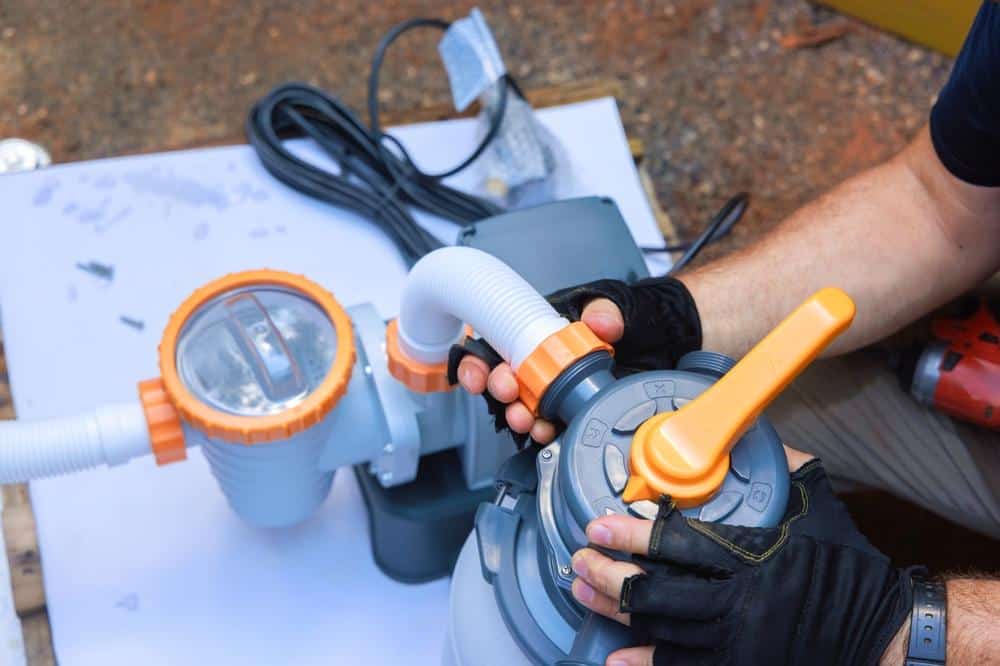
Water enters the system through skimmers, main drains, and dedicated suction lines. The pump’s impeller then draws the water through the basket, moving it through the filter and any optional heater or treatment equipment. Return jets send the filtered water back into the pool, and jet placement affects how evenly the water circulates.
Factors That Determine What Size Pool Pump You Need
Pool volume: Measured in liters or cubic meters, volume is the starting point for any sizing calculation. Larger pools generally need a higher flow rate to circulate the full volume within the target turnover period.
Target turnover time: Turnover is the theoretical time needed to circulate a volume of water equal to the pool’s total volume. The appropriate turnover schedule varies by pool type, use pattern, design, and applicable standards, so there’s no single number that fits every pool.
Total dynamic head (TDH): The resistance the pump must overcome, driven by pipe length, fittings, valves, equipment, and elevation changes. A pump delivers different flow rates depending on the system head, not a single fixed figure.
Plumbing pipe size: Suction and return line diameter, the number of fittings and bends, and existing plumbing limitations all shape how much flow the system can actually carry.
Filter capacity: Pump flow must remain within the filter’s rated flow. A pool filter size calculator is a useful starting point for checking that pump output and filter capacity are compatible.
Additional pool features: Waterfalls, fountains, spa jets, infinity edges, heaters, and UV or ozone systems can each have their own flow demands, sometimes requiring separate pumps or a more detailed hydraulic design.
Pool Pump Size Calculator (A 2-Step Guide)
Step 1: Calculate Pool Volume
For a rectangular pool, multiply length × width × average depth to get volume in cubic meters. One cubic meter equals 1,000 liters.
For a circular pool, use the diameter or radius along with average depth, then convert the result into liters.
For an irregular-shaped pool, divide it into smaller measurable sections, calculate each section separately, and add the results together. Checking design or construction documents, when available, helps confirm accuracy.
Having an accurate pool volume is important when choosing pump sizing, as it also affects chemical dosing, heating calculations, saltwater system sizing, and filtration planning.
Step 2: Calculate the Required Flow Rate
The basic formula is:
Required flow rate = pool volume ÷ turnover time
Once you have the flow rate in liters per hour, you can convert to liters per minute if needed for equipment specifications.
Example 1: What pump size should I get for a 50,000-liter pool? Using an 8-hour turnover assumption for demonstration purposes, the calculation is 50,000 L ÷ 8 hours = 6,250 L/h, or 6.25 m³/h. This is a theoretical minimum flow rate only. It still needs to be checked against the total dynamic head and the manufacturer’s pump performance curve before selecting equipment.
Example 2: What pump size do I need for a 40,000-liter pool? Using the same 8-hour turnover assumption, the calculation is 40,000 L ÷ 8 hours = 5,000 L/h, or 5 m³/h before hydraulic adjustment. As with the 50,000-liter example, this figure is a starting point, not a final pump recommendation.
A water pump size calculator can generate an initial estimate using these same inputs. General calculators, however, often don’t account for pool-specific filtration, sanitation, and water feature requirements, so treat the output as a planning tool.
Using a Calculator Effectively
Before running any calculation for the pump size, gather the pool dimensions and volume, average water depth, target turnover, pipe diameter, estimated total dynamic head, filter flow capacity, and any attached pool features. The calculator result should show flow rate, a pump model or performance range, and the head conditions used. Compare that result against the manufacturer’s actual pump performance curve.
Commercial pools often carry different design requirements. Multiple suction and return lines alter the hydraulic calculations, and water features may impose separate flow demands that a basic calculator won’t capture.
Pool Pump Dimensions, Horsepower, and Speed Options Explained
Pool pump dimensions refer to the unit’s length, width, and height, which are useful for equipment room clearance and service access, not for hydraulic capacity, so don’t confuse a pump’s physical footprint with its performance.
Horsepower differs from pump size. The pump’s actual operating capacity can be determined by examining its performance curve, which illustrates the relationship between flow rate and total dynamic head. Pumps with a single speed operate at a constant rate. Operating them is straightforward, though their energy consumption can be restricted by the specific system. Variable-speed pumps enable adjustable flow for both filtration and water features, potentially saving energy if chosen and set up correctly.
Your pump and filter may be mismatched if there’s high filter pressure, weak circulation, poor water clarity, frequent filter cleaning, and water bypass or other equipment performance problems.
When to Ask a Pool Professional
Bring in a professional to size the pump when:
- You don’t know the pool’s exact volume.
- The existing pump repeatedly loses prime.
- Circulation remains weak despite basic troubleshooting.
- Filter pressure runs unusually high.
- You’re adding a heater, spa, or water feature.
- You’re renovating the pool.
- The equipment room or plumbing system is complex.
- You manage a commercial or high-use pool.
Why Choose Reza Pools & Courts for Pool Pump Installation and Maintenance
Reza Pools & Courts reviews the full pool system, including pool size, circulation requirements, plumbing, filtration, and existing equipment, before recommending a pump. The team matches pump and filter selection to actual system performance requirements rather than pool volume alone.
Our services include pump installation, filter servicing, circulation troubleshooting, equipment repair, preventive maintenance, and pool renovations and upgrades. Our standards are backed by direct experience with Saudi Arabia’s pool conditions, including high temperatures, evaporation, dust and sand exposure, and seasonal shifts in filtration demand.
Contact Reza Pools & Courts for professional pool pump selection, installation, repair, and residential and commercial pool maintenance in Saudi Arabia.
References
- Five Steps to Proper Pool Pump Selection. Retrieved on 20 July 2026 from https://www.aquamagazine.com/builder/article/15710659/five-steps-to-proper-pool-pump-selection
- How to Properly Size a Circulating Pump for Your Pool. Retrieved on 20 July 2026 from https://support.fibropool.com/en-US/how-to-properly-size-a-circulating-pump-for-your-pool-672291