

Swimming pool leaks don’t always have immediate signs, but a water bill that jumps for no obvious reason, a pool needing topping off every few days, and uncertainty over whether it’s Saudi summer heat or a real leak underneath often point to it. Many pool owners only discover leaks after they’ve led to soil erosion, cracked decks, or a significant increase in water costs, as the initial indicators resemble typical water evaporation.
Below, we cover the difference between evaporation and a real leak, the simple tests you can run at home to confirm one, and when the situation calls for professional pool leak repair.
Evaporation or an Actual Leak? How to Tell the Difference
Pools in hot, dry climates like Saudi Arabia lose noticeable water to evaporation alone, especially in peak summer when temperatures push past 45°C. That baseline stays predictable day to day. Splash-out from active use and backwashing during filter cleaning also account for some daily drop, none of which points to a leak.
A real leak, however, has a distinct appearance. Observable indicators of water loss, such as swift nighttime decreases exceeding evaporation rates, waterlogged or collapsing ground around the pool’s structure, air expelled from the return jets, or localized, unexplainable algae blooms, all suggest that water is escaping the pool. A frequently operating autofill valve is typically the earliest and most obvious indicator.
When the pool keeps drawing water without any change in use or weather, something under the surface has shifted.
What’s Really Causing Your Pool to Lose Water
Swimming pool leaks rarely trace back to one single point. Knowing which category is behind the loss determines the right repair approach, so identification is the first step for pool leak detection.
Structural Shell Cracks and Liner Tears
Plaster and concrete cracks develop from ground movement, poor original construction, or simple age. In Saudi Arabia, shifting sandy soil and thermal stress from extreme day-to-night temperature swings contribute significantly. Vinyl liner tears typically appear around seams, steps, and corners where the material gets stretched or scuffed over time. Shell leaks often show visible damage on inspection, though hairline cracks near tile lines and returns can remain hidden unless revealed through dye testing.
Fittings, Plumbing, and Equipment Pad Leaks
Over time, skimmers, returns, lights, and main drains separate from the surrounding shell or concrete they were originally sealed against. These gaps let water escape steadily, often without any visible sign above ground. Underground pool pipe leak repair cases are trickier, as wet spots in landscaping, unexplained pressure drops, or greener grass in one area of the yard usually give them away.
That said, the equipment pad itself is worth checking first before assuming the shell is at fault. Pump seals, filter housings, heater fittings, and valves all leak occasionally, and a puddle at the equipment pad can drain the pool just as effectively as a crack in the wall. A quick pad inspection often saves an unnecessary shell search.
How to Confirm and Track Down a Leak at Home
If the signs point to a leak, there are a few low-cost tests to narrow down the source before involving a professional. Among the methods for how to find a leak in a pool, the bucket test remains the most reliable place to start.
Testing and Tracking a Suspected Leak
Place a bucket on a pool step so its water sits at the same level as the pool water. Fill the bucket to match. After 24 to 48 hours, compare the two levels. If both dropped equally, evaporation is the culprit. If the pool dropped more, the pool has a leak.
Running this test twice, once with the pump on and once with it off, separates a shell leak from a plumbing leak. Water lost only when the pump runs points to pressure-side plumbing, but water lost regardless points to the shell or suction side.
Tip: Mark the water level with tape or a pencil line for a more precise read on the exact drop over time. For pinpointing, applying dye near suspected cracks, returns, and skimmer throats shows exactly where water pulls in.
DIY Pool Leak Fixes and Their Limits
Small, homeowner-safe repairs are possible for a narrow set of leaks. Pool putty can seal minor skimmer separations. Vinyl patch kits handle small liner tears underwater. Loose plumbing unions often just need tightening. In each case, preparing the surface properly matters more than the product itself: cleaning the area, removing loose material, and following cure times so the fix holds.
However, DIY cannot safely handle more serious leaks. Widespread structural cracking, a leak that keeps reappearing in the same spot after patching, or anything suspected to be underground all warrant professional attention. Small leaks left alone almost always grow, and the water they release erodes soil around the pool shell and undermines decking above it.
Routine swimming pool services catch small issues like these during regular visits, before a minor fix turns into a full repair.
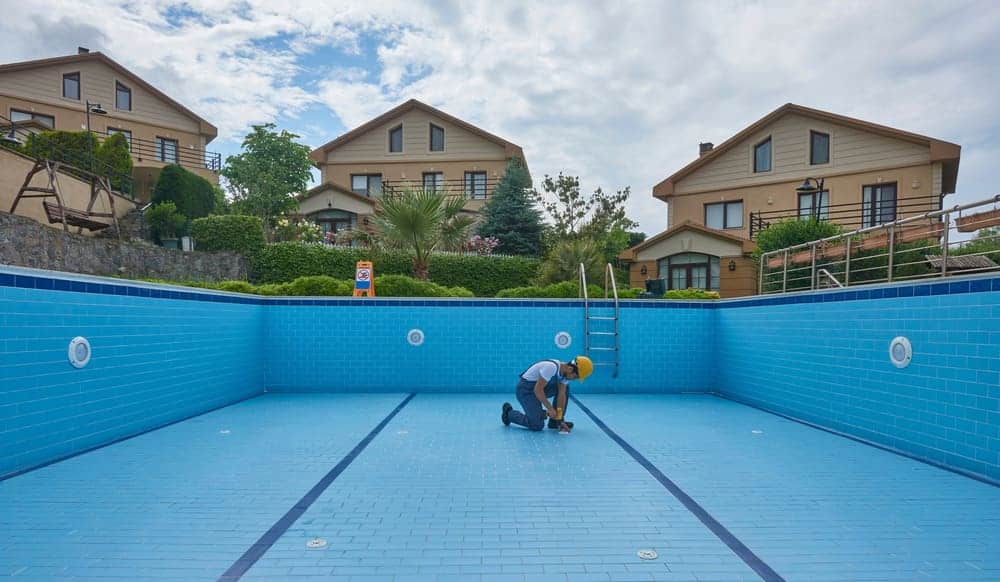
Why Homeowners Trust Reza Pools & Courts for Leak Repair
With over 40 years in building and maintaining pools across Saudi Arabia, Reza Pools & Courts brings hands-on knowledge of how the region’s heat, sandy soil, and thermal stress affect pool structures over time. Our experience spans both residential and commercial properties, from single-family villa pools to large recreational builds at resorts and compounds.
Diagnosis is at the forefront of our approach. Every leak call starts with a full assessment that locates the actual source, whether that means a hairline crack near a return, a separated skimmer throat, or a broken pipe underground. Our repairs target the real problem, which keeps costs down and prevents the same leak from resurfacing weeks later.
Address Pool Leaks Early to Avoid Structural Damage
A pool losing water is not always a crisis. The difference between normal evaporation and a real leak comes down to a few measurable checks, including the bucket test, water-level marking, and a close look at fittings, plumbing, and the equipment pad. If a leak is detected, DIY approaches can handle certain small-scale leaks, but anything beyond that warrants professional help.
At Reza Pools & Courts, we have over 40 years of experience in diagnosing and repairing pools across Saudi Arabia’s demanding climate, and we bring the same precision to pool leak repair that goes into every custom build. Our team knows where leaks hide in Saudi conditions specifically, having the expertise to pinpoint the exact source of a leak, from hairline shell cracks to underground pipe damage, and repair it without unnecessary digging.
Contact Reza Pools & Courts today for in-ground pool leak repairs near me and swimming pool services. Our technicians are here to help patch up your pool and keep it as good as new.
References:
Guidelines for Keeping Your Pool Safe and Healthy. Retrieved July 15, 2026, from https://www.cdc.gov/healthy-swimming/safety/what-you-can-do-to-stay-healthy-in-swimming-pools.html
Guidelines for Safe Recreational Water Environments, Volume 2: Swimming Pools and Similar Environments. Retrieved July 15, 2026, from https://www.who.int/publications/i/item/9241546808